AI in Medical Affairs: Five Shifts That Will Reshape Healthcare in the Next Five Years
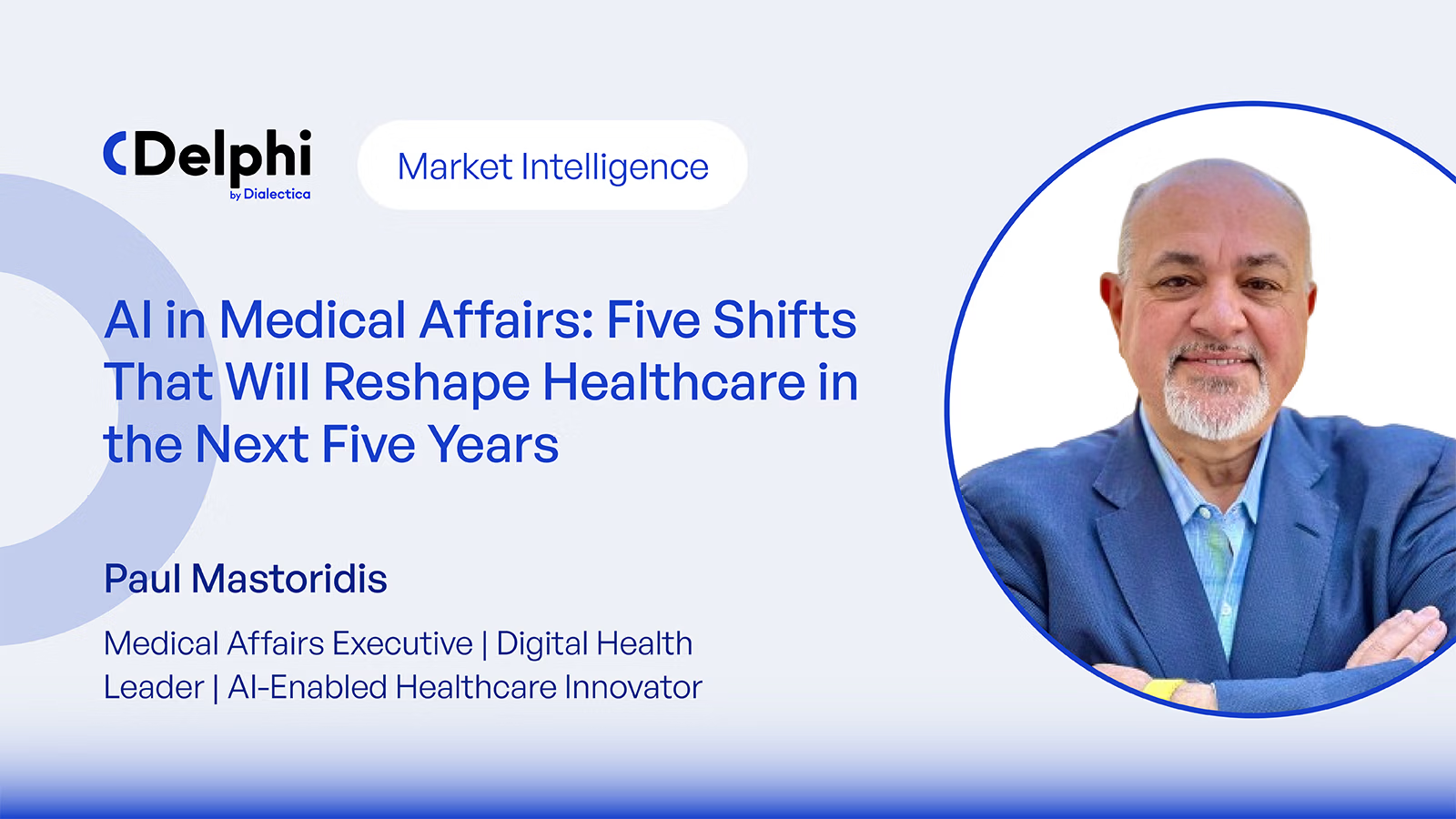

By Paul Mastoridis | Medical Affairs Executive | Digital Health Leader | AI-Enabled Healthcare Innovator
AI in Medical Affairs is no longer a future concept. The shift from experimentation to implementation is already underway. Over the next five years, it will fundamentally reshape how evidence is generated, how science is communicated, and how Medical Affairs functions within life sciences organizations.
Many people still talk about AI in healthcare as something on the horizon. After more than 20 years leading Medical Affairs organizations, developing digital health solutions, and working at the intersection of science, technology, and patient care, including contributing to one of the first AI technologies designed to differentiate asthma from COPD, my view is different.
AI is already here. What is happening now is not experimentation. It is implementation. And Medical Affairs professionals have a unique opportunity to lead that shift, or be left behind by it.
Here are the five transformations I believe will define the next five years.
1. Evidence Generation Will Move From Years to Near Real-Time
Generating clinical and real-world evidence has historically been slow. Medical Affairs teams spend significant time collecting, analyzing, interpreting, and disseminating data, often waiting months to understand treatment trends, patient adherence challenges, or outcomes patterns.
AI changes the speed of that process fundamentally. By identifying meaningful patterns across vast amounts of real-world evidence far faster than human teams can, AI will give Medical Affairs organizations near real-time insight into what is happening in clinical practice.
This is not about replacing scientific expertise. It is about augmenting human expertise with the ability to process information at a scale and speed that was previously impossible. The teams that move fastest here will be able to answer critical clinical questions sooner and support healthcare providers with more timely, evidence-based information.
2. Scientific Communications Will Become Smarter and More Responsive
Medical Information departments today manage thousands of inquiries from healthcare professionals. The process is time-intensive and often produces generic responses that do not reflect the specific clinical context of the question being asked.
AI-powered platforms will change that in two important ways.
First, they will enable faster, more accurate, and more personalized responses to complex clinical questions, covering efficacy, safety, patient selection, and disease management, while maintaining scientific rigor and compliance.
Second, and perhaps more consequentially for field teams, they will transform how Medical Science Liaisons prepare for scientific exchange. Rather than spending hours searching databases and publications before an engagement, AI will surface emerging scientific trends, key publications, investigator interests, and educational opportunities in advance. MSLs will spend less time searching and more time delivering genuine scientific value.
3. Stakeholder Engagement Will Finally Match the Complexity of the Audience
Healthcare is becoming increasingly personalized. Medical Affairs has been slow to follow.
Today, most organizations deliver broadly similar scientific content across very different audiences: healthcare providers, health systems, payers, advocacy groups, and patients, each with distinct needs, clinical challenges, and information preferences. AI will make it possible to understand those differences at scale and tailor communications accordingly.
The goal is not marketing. It is delivering the right scientific information to the right stakeholder at the right time. Done well, that creates more productive scientific partnerships. Done at scale, it improves patient care.
4. Earlier Diagnosis and More Effective Disease Management Will Become Standard
This is where the patient impact becomes most direct.
Healthcare is generating enormous amounts of data: electronic health records, digital therapeutics, wearable devices, remote monitoring systems, patient-reported outcomes. The challenge has never been the volume of data. It has been the ability to interpret it quickly enough to act.
AI is already showing meaningful results in respiratory medicine, cardiovascular disease, oncology, and rare diseases. Over the next five years, Medical Affairs organizations will play a central role in this shift: validating AI-driven technologies, generating evidence for their use, supporting clinical adoption, and ensuring that healthcare professionals understand both the opportunities and the limitations of AI-powered decision support.
The organizations that successfully integrate AI into clinical workflows while maintaining scientific integrity will create real advantages for patients and healthcare systems. That is not a prediction. It is already beginning to happen.
5. Medical Affairs Will Become the Strategic Intelligence Hub of Life Sciences
This is the shift I find most significant, and the one most people in the industry are underestimating.
Historically, Medical Affairs has been viewed primarily as a function focused on data dissemination and scientific support. That framing is becoming obsolete. Over the next five years, AI will empower Medical Affairs teams to connect insights across clinical development, commercial strategy, market access, patient support, and healthcare delivery in ways that no single function has been able to do before.
Medical Affairs leaders will not simply communicate evidence. They will help organizations predict future needs, identify emerging trends, evaluate new technologies, and guide strategic decisions using data-driven intelligence. In many life sciences organizations, Medical Affairs will become one of the most influential functions in the building.
That is an opportunity. It is also a responsibility.
The Responsibility Side of This Shift
The opportunities above are real. So are the risks.
AI is only as good as the data used to train it. Medical Affairs leaders must ensure transparency, data quality, governance, regulatory compliance, and ethical implementation across every application. Concerns around bias, privacy, explainability, and patient trust are not compliance checkboxes. They are foundational to whether these tools work as intended and whether clinicians and patients will actually trust them.
Technology should never replace human judgment. The future belongs to organizations that combine the processing power of AI with the expertise, empathy, and scientific credibility that only healthcare professionals can provide.
What I Expect to See by 2031
Based on the trajectory I am observing across the industry, here is what I believe will be true within five years:
- AI integrated into nearly every Medical Affairs function
- Faster real-world evidence generation and analysis as standard practice
- Intelligent scientific communication platforms available around the clock
- Predictive analytics for patient outcomes embedded in clinical decision-making
- Wider adoption of digital biomarkers and remote monitoring technologies
- Genuinely personalized engagement with healthcare professionals at scale
- Medical Affairs assuming a central strategic leadership role in healthcare innovation
The Q&A
Is the Medical Affairs function ready for AI integration, or is this still primarily aspirational?
The honest answer is: it depends on the organization. The experimentation phase is over for leading life sciences companies. The shift now is from proof-of-concept to enterprise-scale implementation. What separates the organizations moving fastest is not access to technology. It is data governance, organizational readiness, and leadership that understands both the scientific and the operational dimensions of what AI actually requires to work reliably in a regulated environment.
Where is AI likely to create the most disruption within Medical Affairs in the near term?
Scientific communications and evidence generation are the two areas where the impact will be felt first and most visibly. Both involve high-volume, information-intensive work where AI can create immediate efficiency gains without requiring the full organizational transformation that functions like stakeholder engagement or strategic planning demand. MSL productivity is another near-term area to watch. The shift from information retrieval to insight-led scientific exchange will happen faster than most teams are currently prepared for.
How should Medical Affairs leaders think about the governance and compliance dimensions of AI adoption?
Start with the data. Every AI application in a regulated environment is only as trustworthy as the data it was trained on and the governance structures surrounding it. Medical Affairs leaders need to be active participants in defining those structures, not passive recipients of tools built by technology teams who may not fully understand the scientific and regulatory context. That means investing in literacy across the function, not just among digital leads, so that the people closest to clinical practice can meaningfully evaluate what these tools are doing and flag where they fall short.
Paul Mastoridis is a Medical Affairs executive with more than 20 years of experience building and leading Medical Affairs organizations across pharmaceuticals, medical devices, and AI-enabled healthcare. He has developed digital adherence solutions, AI-powered healthcare platforms, and contributed to the development of one of the first AI technologies designed to differentiate asthma from COPD. His work sits at the intersection of science, technology, patient care, and innovation.