-p-1600.avif)


.avif)
Why Data Centers Are Moving to Liquid Cooling and What It Means for Infrastructure Investment

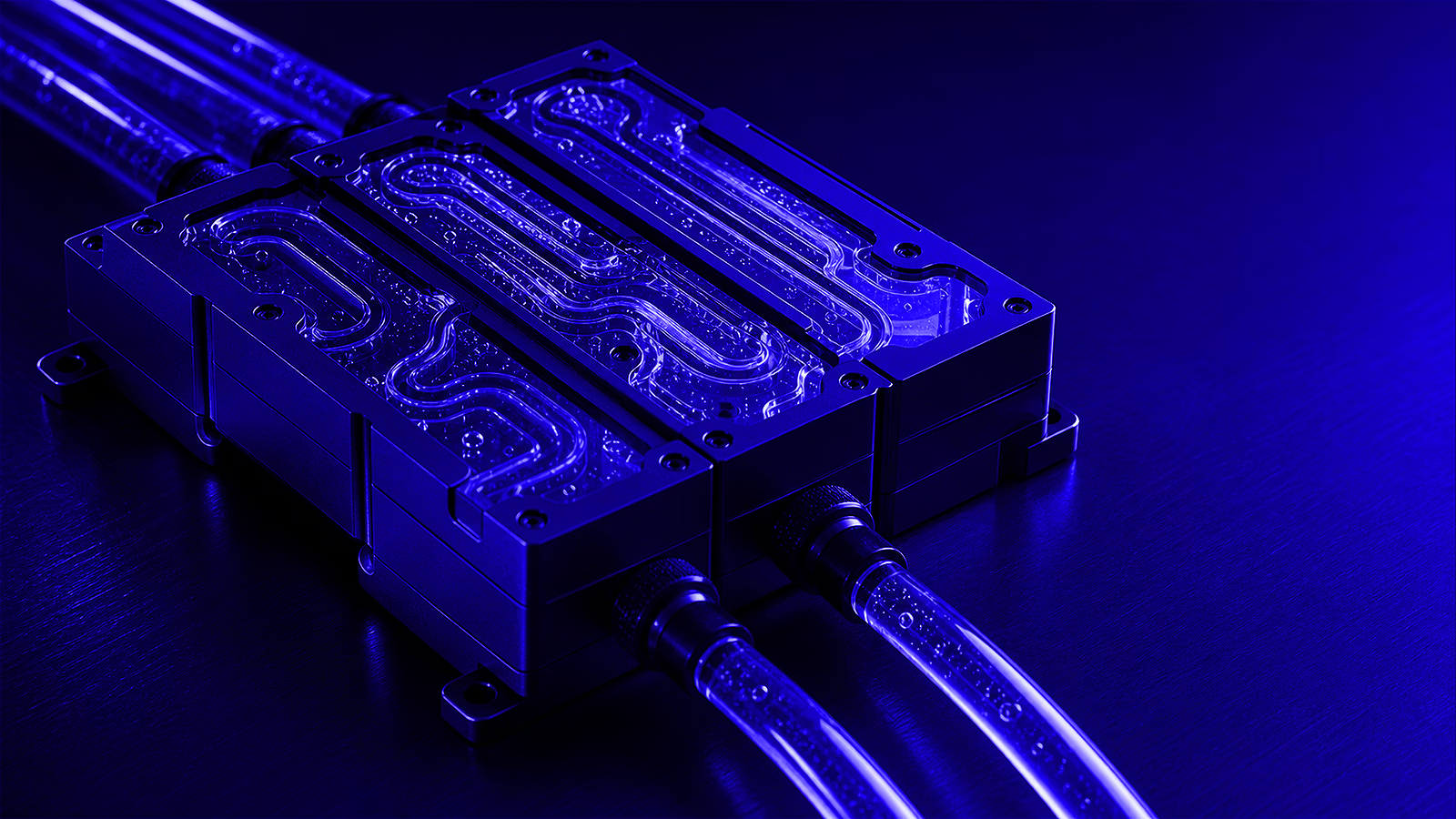
The data center cooling market is undergoing a structural transition as AI workloads push rack power requirements beyond the operational ceiling of traditional air-based systems. Specialized mechanical infrastructure now represents roughly one-fifth to one-quarter of total facility construction costs. Adoption timelines remain constrained by industry conservatism, supply chain complexity, and regulatory divergence across geographies.
The Operational Pressure Behind a Market in Transition
There is an ongoing debate about the implications of AI adoption — and one of the most concrete, measurable consequences plays out not in boardrooms but in the physical infrastructure underneath modern compute environments.
Insights from Dialectica's expert network indicate that escalating processing densities from AI workloads are forcing an operational transition within the data center cooling market, driving a measurable shift away from traditional air-based structures toward more advanced liquid deployment methods.
Views expressed by executives within Dialectica's network indicate that specialized mechanical infrastructure now accounts for roughly one-fifth to one-quarter of overall facility core construction expenditures. That share reflects the growing engineering complexity required by modern server rack architectures, which frequently demand double-digit kilowatt power capacities per enclosure.
Two structural forces are now in direct tension:
- The sector's built-in conservatism, which primary interviews with industry experts suggest requires new thermal technologies to demonstrate stable field performance for roughly five years before global rollout is authorized
- The pace of AI workload growth, which is outpacing that traditional adoption cycle
Established equipment providers are responding by acquiring specialized thermal engineering firms. At the same time, regulatory pressures and geographic constraints continue to reshape where and how facilities can be built.
Intelligence Matrix: Data Center Cooling Market at a Glance
Cooling Architecture: The Technology Landscape
Air-Based Frameworks
Industry expert consultations suggest that operators continue to favor air cooling where it remains operationally viable. Air-based systems are natively integrated into existing facility layouts and require no fundamental architectural redesign. Standard enhancements include rear-door heat exchangers, which capture localized thermal energy before it disperses into the ambient room environment.
But there is a defined operational ceiling. Once rack power density reaches the higher end of the double-digit kilowatt range, air-based methods become structurally insufficient and operators face a more consequential architectural decision about the degree and nature of liquid integration.
Direct-to-Chip Liquid Cooling
Primary research conducted via Dialectica indicates that high-intensity compute operations, particularly those supporting AI inference and training workloads, increasingly require fluid-delivery lines routed through cold plate structures directly to core processors.
These configurations operate primarily as parasitic subsystems drawing on existing chilled-water infrastructure rather than requiring a complete redesign of the building's mechanical plant. That characteristic makes direct-to-chip cooling a realistic near-term path for operators upgrading existing facilities, avoiding the capital intensity of full architectural replacement.
- Integrates with existing chilled-water loops without full facility modification
- Cold plates target the highest heat-generating components specifically
- Suited to density-driven retrofits in legacy environments
Immersion Cooling
Commentary from expert advisors in Dialectica's network suggests that total liquid immersion generates significant industry media attention but remains largely impractical for broad commercial deployment. Maintenance procedures in active white space are substantially more complex when hardware is fully submerged, and managing refresh cycles and fluid containment in production environments creates friction that most commercial operators have not resolved at scale. Immersion cooling is likely to remain viable in specialized deployments rather than as a mainstream architecture for the foreseeable future.
Facility Design and Supply Chain Dynamics
Large-scale data center infrastructure operates on timelines that distinguish it from almost every other technology sector. According to anonymized expert interviews conducted by Dialectica, these projects involve multiple years of planning and construction, followed by facility lifecycles that extend across decades. Every architectural decision made at the design stage carries consequences that are both long-term and costly to reverse.
Retrofitting carries significant capital requirements. Primary research conducted via Dialectica indicates that integrating localized liquid loops into existing air-cooled facilities involves substantial capital expenditure. These structural adaptations are typically financed through direct client modification agreements rather than speculative operator investment.
The hybrid design model is gaining adoption. Insights from industry leaders consulted through Dialectica suggest that developers in emerging geographic clusters are increasingly building flexible hybrid environments. The approach involves:
- Constructing a core air-cooled framework as the base architecture
- Engineering pre-built structural capacity for liquid-delivery subsystems from the outset
- Activating that capacity only when tenant density profiles justify the investment
This is as much a capital allocation strategy as a technical one — it avoids over-committing to liquid infrastructure before demand confirms it, while eliminating the need for a full rebuild later.
Custom component procurement introduces timeline risk. Views expressed by executives within Dialectica's network indicate that implementing advanced liquid solutions can push project commissioning timelines back by several months when specialized parts are required. This is a planning variable that is increasingly factored into project scheduling from the outset.
Market Entry Barriers and Consolidation Activity
Insights from industry leaders consulted through Dialectica suggest that barriers to entry vary significantly across the server infrastructure value chain:
- Semiconductor layer: Financial requirements and intellectual property concentration create exceptionally high entry barriers
- Cooling layer: Relatively lower entry hurdles, enabling specialized engineering firms to develop differentiated heat-dissipation approaches for high-performance compute environments
That accessibility in the cooling segment has produced a more fragmented competitive landscape at the component level. But consolidation is proceeding rapidly at the systems and platform level.
Primary interviews with industry experts suggest that larger, established cooling manufacturers are actively acquiring smaller firms with specialized capabilities in cold plate technology and advanced thermal management. The strategic rationale is consistent with patterns seen across infrastructure sectors during technology transitions: incumbents using acquisition to access innovation where internal development would take longer and carry higher execution risk.
Myth vs. What Experts Actually Say
Thermal Tolerances and Regulatory Impact
Processor Advances Are Shifting Cooling Baselines
Insights from Dialectica's executive network suggest that ongoing advances in processor design are materially affecting baseline cooling requirements. Key developments include:
- Recent silicon generations allow processors to operate at higher water inlet temperatures than prior generations required
- This expanded thermal tolerance reduces the structural requirement for large-scale chiller installations in certain climates
- The downstream effect is already surfacing in public market valuations for legacy industrial refrigeration equipment suppliers
Regional Regulatory Divergence
According to anonymized expert interviews conducted by Dialectica, regional regulations governing environmental impact, greenhouse gas emissions, and real estate utilization are directly shaping how international developers structure speculative projects.
Certain European urban zones require extensive approval pathways tied to municipal power restrictions and space allocation criteria. The practical consequences are significant:
- Measurable operational and timeline disparities between primary metropolitan markets and secondary regional ones
- Site selection and capital allocation decisions increasingly shaped by regulatory approval timelines at the earliest project stages
- Secondary regional markets offer reduced regulatory friction, but may present trade-offs in infrastructure availability and connectivity
Investor FAQs
What is driving the structural shift from air to liquid cooling in data centers?
A: Primary research conducted via Dialectica indicates that the primary driver is rack-level power density. Standard cabinet configurations historically operated at conservative single-digit kilowatt levels. Modern AI workloads have pushed requirements into the double-digit kilowatt range per enclosure, and once density crosses the threshold at which air-based methods become insufficient, operators are required to evaluate liquid infrastructure. The transition is demand-driven.
How significant is cooling infrastructure as a proportion of total facility construction cost?
A: Views expressed by executives within Dialectica's network indicate that specialized mechanical infrastructure represents approximately one-fifth to one-quarter of total core facility construction expenditure, a proportion that has grown alongside the increasing engineering complexity of cooling architectures required for high-density AI workloads.
Why has immersion cooling not achieved broader commercial deployment?
A: Commentary from expert advisors in Dialectica's network suggests that the constraints are operational rather than technical. Maintenance in active white space is significantly more complex for fully submerged systems, and managing hardware refresh cycles and fluid containment in production environments creates friction that most commercial operators have not resolved at scale.
What is the realistic adoption timeline for new cooling technologies?
A: Industry expert consultations suggest that operators require approximately five years of demonstrated field stability before a new thermal technology achieves broad commercial adoption. This reflects the multi-decade lifecycle of facility infrastructure and the capital intensity of architectural change.
How are developers managing uncertainty about future cooling requirements?
A: Insights from industry leaders consulted through Dialectica suggest that developers are adopting hybrid design frameworks — air-cooled core architecture with pre-built structural capacity to integrate liquid-delivery subsystems if future tenant density profiles require it. This manages capital risk while preserving the option to upgrade without a full architectural rebuild.
What role is M&A activity playing in the cooling market's competitive structure?
A: According to anonymized expert interviews conducted by Dialectica, established cooling manufacturers are actively acquiring smaller firms with specialized capabilities in cold plate technology and advanced thermal management, using acquisition to access capabilities in a segment where entry barriers are relatively low and specialized firms have developed competitive positions.
Strategic Implications
The data center cooling market has moved from a background infrastructure consideration to a central variable in facility investment, site selection, and technology procurement decisions. Several dynamics merit particular attention:
Liquid cooling is not displacing air cooling. It is being adopted at the specific density thresholds where air-based systems become insufficient, creating a bifurcated market segmented by workload type. Understanding where those thresholds fall in specific deployment contexts matters more than a general view on cooling technology preference.
The five-year adoption cycle is both a constraint and a signal. Technologies currently entering stable commercial production are the candidates for broad rollout by the latter part of this decade. Tracking which thermal approaches are achieving that production maturity now has practical value for long-range capital planning.
Regulatory geography is a determinant of project viability, not just compliance cost. The divergence between primary metropolitan markets and secondary regional ones is a structural feature of the current landscape. Site selection decisions that do not account for municipal power restrictions and approval pathway timelines carry meaningful execution risk.
Consolidation remains in its earlier stages. Established manufacturers are acquiring for capability access rather than revenue scale — suggesting acquisition premiums for specialized thermal engineering firms with defensible technology positions may persist through the near term.
Sources and External Signals
All primary insights are drawn from anonymized expert interviews and executive network research conducted by Dialectica. The following external sources were referenced for contextual corroboration:
- International Energy Agency (IEA) — Energy and AI: Executive Summary and Energy Demand from AI — data center electricity consumption trends and AI-driven power density growth projections through 2030
- U.S. Department of Energy / Lawrence Berkeley National Laboratory — 2024 United States Data Center Energy Usage Report — historical and projected U.S. data center electricity demand, cooling system scenarios, and GPU infrastructure analysis
- European Commission, Directorate-General for Energy — EU-Wide Scheme for Rating Sustainability of Data Centres and Energy Performance of Data Centres — regulatory reporting requirements under the Energy Efficiency Directive (EU) 2023/1791 and Delegated Regulation EU/2024/1364
- IEEE Xplore — The Inevitable Shift to Liquid Cooling in Data Centers and Advancing Sustainability in Data Centers: Evaluation of Hybrid Air/Liquid Cooling Schemes — peer-reviewed research on thermal management architectures, cooling fluid performance, and hybrid air/liquid deployment strategies in high-performance computing environments
This article is produced for informational purposes only. It does not constitute investment advice, operational guidance, or recommendations of any kind. All insights reflect anonymized research from Dialectica's expert network and do not represent the institutional views of Dialectica.