Most Boards Are Governing the Company They Used to Run
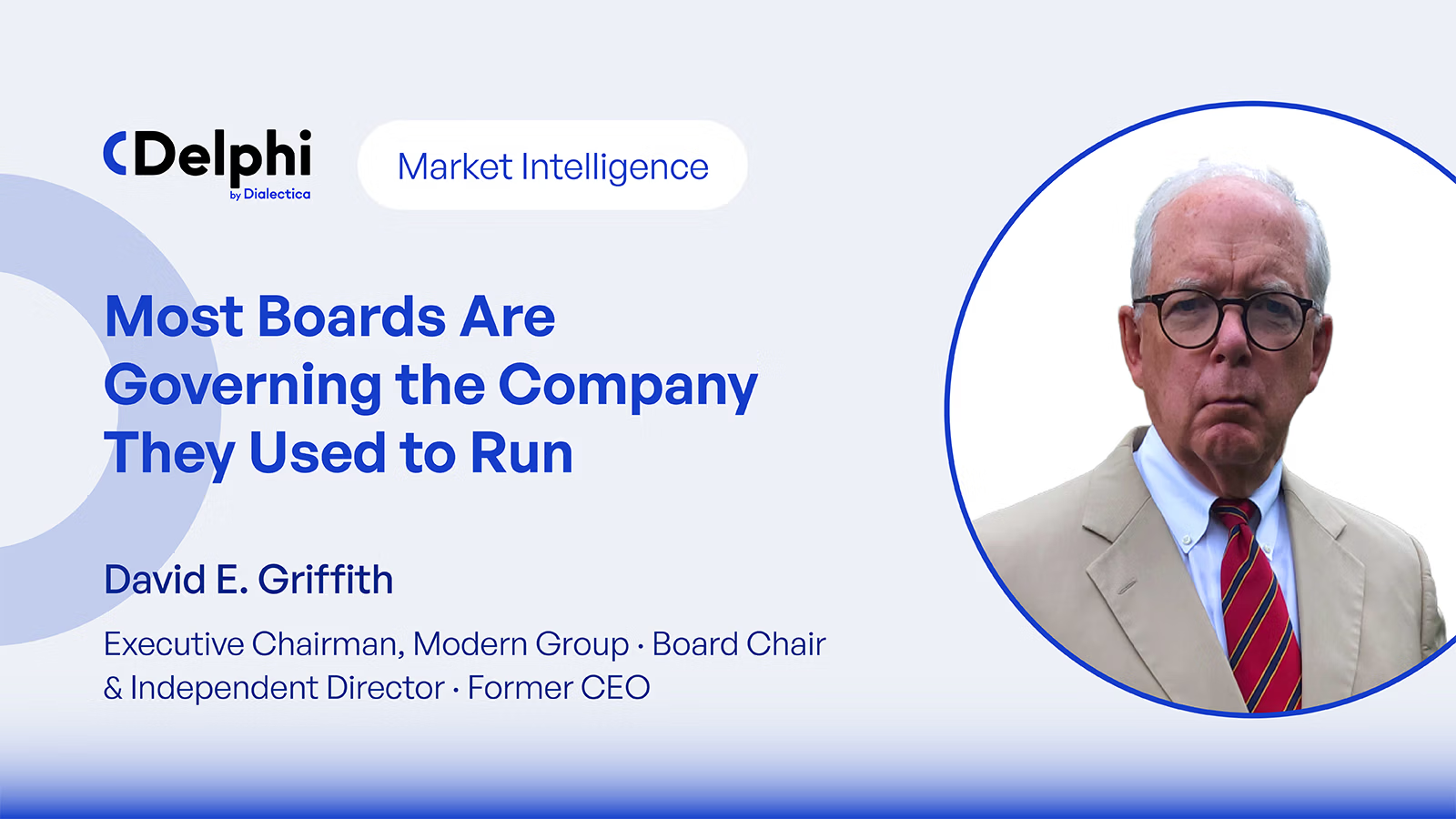

By David E. Griffith Chairman, Modern Group Ltd.
The best advice I ever received came early in my career: wear muddy boots. Go into the field. Ask two questions: how are we doing, and what could we do better? Then be quiet and listen.
That stuck with me. After decades on boards across manufacturing, financial services, healthcare, education, and community development, I keep coming back to it. Because the most underutilised principle in governance is not some sophisticated framework. It is that one.
Most boards are not failing because of fraud or negligence. They are failing because of drift. And drift, in governance, is the hardest failure to see from inside the room.
The Framework That Worked. Until It Didn't.
Here is the honest version of the problem: most governance frameworks in use today were built for a different era. Stable environments, predictable capital flows, a commercial logic that prized efficiency above everything. In that world, a certain kind of board structure made sense.
What it was never designed for is the compounding complexity that now defines how organisations actually operate: AI disruption, geopolitical fragility, evolving ESG obligations, activist shareholders, and a stakeholder landscape that no longer extends automatic deference to institutional authority.
Good governance at its core is the same across sectors. The principles hold whether you are running a publicly listed manufacturer or a community development non-profit. What changes is the scale, the regulatory environment, and the nature of the risks. What should not change is the quality of the judgment being applied.
But most boards are not applying the right judgment. They are applying the judgment that worked in the environment they were constituted for. Not the one they are operating in today.
The Conversation Most Boards Keep Postponing
The structural issue is not complicated: the skills that justified a director's seat a decade ago may not be the skills the organisation needs now.
Boards are extraordinarily reluctant to confront this. The mechanisms exist: rigorous self-assessment, honest succession planning, the willingness to rotate directors out when their contribution has peaked. They exist in most governance frameworks. They are almost never applied with any real discipline.
This matters. A board constituted for yesterday's challenges will systematically underweight the risks and opportunities of today's. The misalignment compounds quietly, over years, until the organisation encounters a disruption it was never set up to manage. By then, the window to address it cleanly has usually closed.
The organisations getting this right treat board composition as a living question, not a settled one. They ask regularly whether current directors, individually and collectively, have what the organisation actually needs now, not what they had when they were appointed. And then they act on what they find. That last part is where most stop short.
Information Isn't the Problem. Judgment Is.
There is a distinction worth making between information and intelligence. Information has not been the problem for most boards. Directors receive extensive briefing materials, management reports, external analysis, expert commentary. The volume of input is rarely the issue.
What most boards lack is the ability to convert that information into timely, operationally relevant judgment.
Military organisations have grappled with this for decades. The discipline of structured threat assessment, scenario planning, deliberate red-teaming, asking not just "what is happening?" but "what does this mean for our position, and what do we need to do before it forces our hand?" All of it translates directly into commercial governance. Boards that have imported these approaches consistently outperform those relying on reactive management when conditions turn difficult.
The gap between a board with genuine intelligence and one with a risk register and a quarterly review is not a process gap. It is a judgment gap. And judgment requires the right people, asking the right questions, with enough real knowledge of the operations to recognise when an answer does not add up.
That brings the muddy boots principle back into focus. You cannot govern what you do not understand. And you cannot understand an organisation from thirty thousand feet.
What Getting It Right Actually Looks Like
Before anyone joins a board, three questions deserve honest answers. Are you genuinely aligned with the mission? Are you prepared to work between meetings, not just during them? And do you bring something the board actually needs that it currently lacks?
If the answer to any of those is uncertain, the conversation should stop there.
A board seat is not an honorific. It is a responsibility. The most effective boards I have sat on share one thing: the directors do not just show up. They read the materials. They ask the uncomfortable questions in the room, not in the parking lot afterward. They hold management accountable without micromanaging. That balance (oversight without interference) is genuinely hard to sustain. Most boards struggle with it.
The people closest to the work almost always know the most about it. The best boards find ways to hear from them directly, not to undermine leadership, but to test the assumptions that get built into every slide deck before it reaches the boardroom. The boardrooms that create real, lasting value are the ones where directors know the operations well enough to ask the question that cuts through.
Three Questions Worth Asking Before the Crisis Forces Them
Three questions deserve attention right now, regardless of sector or size.
Does your board have a genuine picture of its own composition gaps? Not a skills matrix filed annually, but an honest assessment of whether the directors currently seated have the expertise and operational knowledge to govern the organisation as it exists today, not as it existed when they were appointed.
Is your board evaluating itself with the same rigour it applies to management? Most governance frameworks include a self-assessment mechanism. Very few apply it with any real discipline. A board that holds management to a performance standard it does not apply to itself is not governing. It is performing governance. Those are different things.
At what point does drift become structural? The warning signs are usually visible well before the consequences become unavoidable: directors who have stopped challenging, an agenda dominated by compliance reporting, a culture where difficult questions get smoothed over rather than worked through. Boards that recognise these signals early enough to act on them are the exception. Most wait until the disruption forces the issue.
The Q&A
How should a CEO distinguish between a short-term governance weakness and a structural problem that demands a strategic response?
Watch the pattern, not the incident. A single governance failure is an event. A pattern of similar failures (decisions never properly tested, risks visible but never escalated, management held to account in words but not in outcomes) is structural. The right question is not "how do we fix this?" but "what does the existence of this pattern tell us about the board's actual capacity to govern?"
What does meaningful board self-assessment actually look like?
It starts with honest individual conversation. A director willing to say, privately, that another director is no longer contributing at the required level, or that their own expertise has become less relevant to the challenges the organisation now faces. That kind of honesty is culturally difficult and structurally rare. The organisations that achieve it tend to have an independent facilitation process, clear criteria, and board leadership willing to act on what surfaces, not just file the findings and move on.
Where should organisations invest to close the governance intelligence gap?
In people who actually understand the operations and the risk environment, not just the financial summary. In scenario planning that models a range of outcomes, not just the base case. In treating board composition as a regular strategic question rather than a matter to revisit only when something goes wrong. The gap between boards that do this and those that do not is not a process gap. It is a judgment gap. And judgment requires both the right people and the conditions in which they can function honestly.
How does a board avoid becoming habituated to persistent underperformance in a way that blinds it to a deeper structural failure?
The gradual erosion of standards is the most dangerous governance failure because it is invisible from inside the pattern. By the time it becomes obvious, it is usually expensive to reverse. The answer is a pre-committed framework: agreed indicators, reviewed at set intervals, with a predetermined response when those indicators are not met. Not subject to short-term relational or reputational pressure. Not a conversation to have when it becomes convenient.
The signal is almost always there before the crisis. The muddy boots principle applies here too. The question is whether anyone is actually paying attention.
David E. Griffith is Chairman of Modern Group Ltd., a diversified industrial company based in Bristol, Pennsylvania. Over a career spanning more than four decades, he has served as board director, committee chair, and executive across manufacturing, financial services, healthcare, education, and community development. He is a nationally recognised speaker and author on leadership, governance, and family business, and the author of the Muddy Boots Blog.