-p-1600.avif)


.avif)
Private Label Growth in the US: Why Most Brands Are Still Getting It Wrong
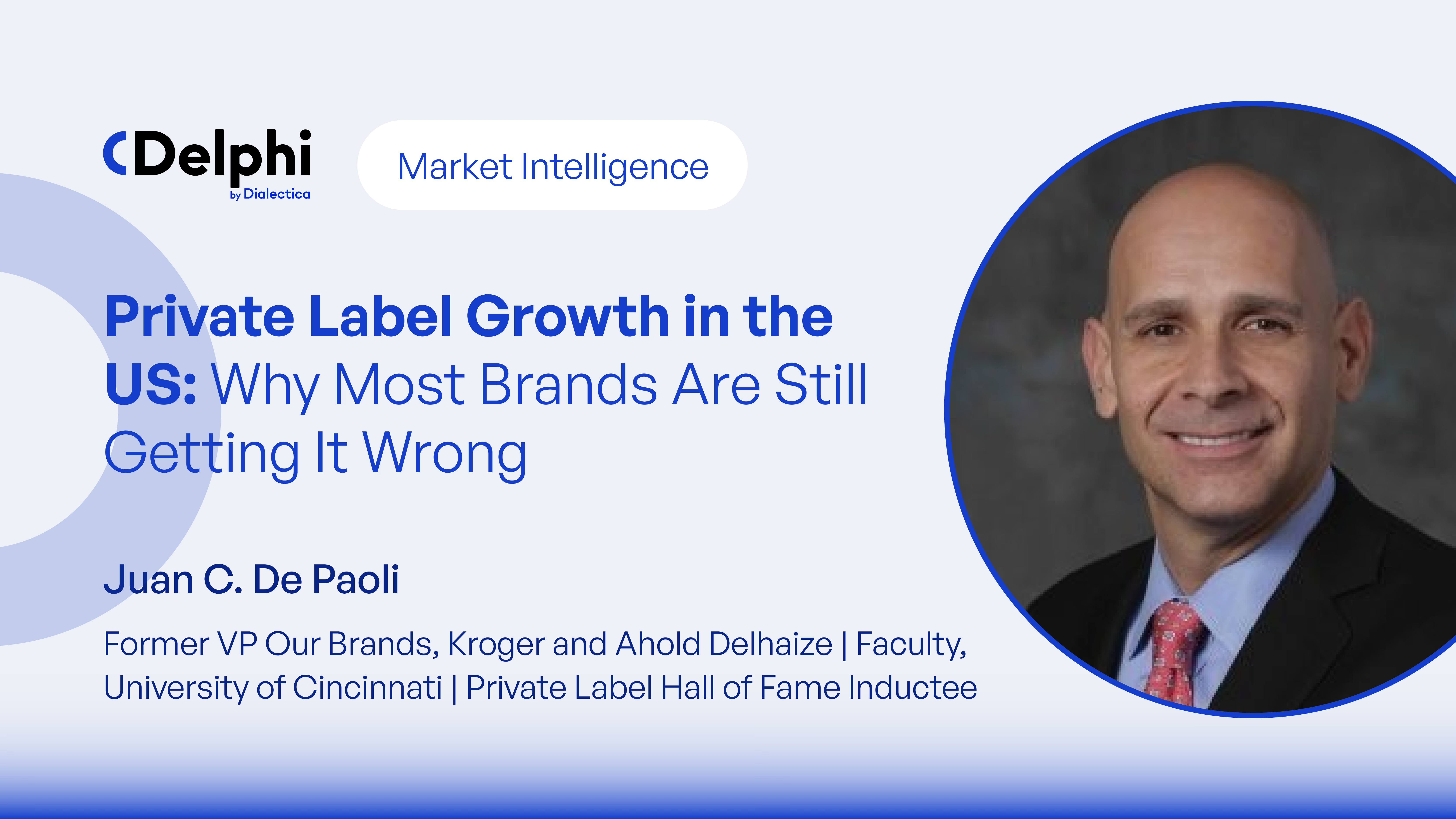

By Juan C. De Paoli | Former VP Our Brands, Kroger and Ahold Delhaize | Faculty, University of Cincinnati | Private Label Hall of Fame Inductee
Private label in the US has now outpaced national brands in both dollar and unit sales growth for three consecutive years, reaching a record $282.8 billion in 2025. The industry keeps calling it a price story. It is not. It never was.
The industry has been telling itself the same story for years. Private labels grow when consumers feel squeezed. Prices go up, shoppers trade down, store brands win. Prices normalize, branded products recover. The cycle repeats.
That story made sense for a long time. It no longer does.
U.S. sales of store brands reached a record $282.8 billion in 2025, up more than $9 billion from 2024, which was itself a record year. Private label brands have now outpaced national brands in both dollar and unit sales growth for three consecutive years. That is not a recession story. That is a structural shift. And the longer the industry keeps explaining it through the lens of price, the longer it will take to understand what is actually happening, and what to do about it.
The Narrative Gets It Backwards
The most common mistake I see is treating private label growth as a consumer response to economic pressure, as if retailers backed into a winning position simply because times got tough. That framing misses the real story entirely.
The retailers who have consistently gained share, and I saw this directly across my time leading Our Brands at H-E-B, Kroger and Ahold Delhaize USA, did not win because they got cheaper. They won because they got braver:
- Braver on quality
- Braver on design
- Braver on entering categories where the national brand leader had left a gap it could not or would not fill without cannibalizing its own portfolio
The biggest share gains I observed came from a specific pattern: identifying a problem in a category that the incumbent brand was structurally prevented from solving. A cleaner label. A format the consumer wanted but that no branded player could offer without undermining a more profitable SKU. A price tier that made commercial sense for the retailer but that a large CPG company simply could not occupy without disrupting its own margin structure.
In each of these cases, the retailer did not compete on price. It competed on judgement. And it won by solving a problem no one else would.
Over the past six years, private brands in the U.S. consumer goods sector grew market share from 18% in 2019 to close to 21% by 2024. That trajectory did not happen because retailers put cheaper products on shelves. It happened because the best operators finally started behaving like brand owners rather than margin managers.
What Actually Drives Repeat Purchase
Price gets you tried once. That is its limit.
What drives repeat purchase is consistent quality and what I would call assortment authority: the sense, category by category, that the retailer's own brand has earned the right to be there on merit, not just price positioning. When consumers start choosing a store brand not because it costs less but because they trust it, the economics of the retailer's entire brand portfolio change:
- Margin improves
- Loyalty strengthens
- The dynamic with national brand suppliers shifts, because the retailer now has real leverage
The industry keeps measuring private label performance on the price index because that is the easiest number to pull. It is also the wrong number. The meaningful signal is unit market share, not just dollar share, because unit share growth in the face of narrowing price gaps is what tells you the consumer has actually changed behaviour, not just responded to a promotion.
Dollar market share reached 21.2% and unit market share hit 23.8% in the first half of 2026, both all-time highs. The gap between those two figures, unit share running ahead of dollar share, is exactly what a shift in perceived quality looks like in the data. Consumers are choosing store brands even when the price gap is smaller than it used to be. That is the real story.
What a Genuine Competitive Response Looks Like
National brands have known about this problem for years. Most have not responded to it effectively, and the reason is structural rather than strategic.
A real competitive response is not a price cut, a pack-size reshuffle, or a coupon campaign. It is a hard look at which SKUs in the portfolio no longer earn their shelf position against the retailer's own label, and having the discipline to reallocate innovation investment there instead of defending the entire lineup evenly.
The structural problem runs deep. Most manufacturers are organized in brand silos with P&L structures that punish anyone who admits a brand is vulnerable. Add to that the commercial relationship complexity:
- The sales team managing the trade account is working to maintain and grow the partnership with the retailer
- The brand team is competing for shelf space against that same retailer's own label
Those two mandates are in direct conflict, and they are rarely resolved at the P&L level. Until that internal conflict is addressed structurally, most responses will continue to be defensive promotion rather than genuine repositioning. Brands will win back a point of share in a quarter, lose it the next, and call it market volatility rather than what it actually is: a permanent change in the competitive landscape.
The Data Advantage No National Brand Has
There is one factor that rarely gets discussed in the price narrative, and it is perhaps the most consequential long-term advantage that leading retailers have built: proprietary consumer data.
Having spent more than 30 years in product development and brand strategy, and overseeing the launch of more than 25,000 products across food, household, pet care, and personal care categories, one thing becomes clear at that scale: the data advantage matters more than most people realize.
A national brand knows what it sells. A sophisticated retailer knows who buys what, how often, in what combination, and what else goes in the basket. That data, applied to own-brand development and category management, creates an insight advantage that no amount of external market research can fully replicate. It informs:
- Which categories to enter
- Which product attributes matter most to high-value shoppers
- Which price points are genuinely elastic, and which are not
This is not a future capability. The leading retailers are already using it. The United States still sits in eleventh place globally in private label penetration, at approximately 20.5% of grocery sales, compared to the UK at 49.5% and Switzerland at 47.2%. The headroom for further growth is significant, and the retailers best positioned to capture it are those who have invested in understanding their shoppers at a granularity that national brands simply cannot match.
What the Shelf Will Look Like in Five Years
The conversation I am not hearing enough of is what the endgame looks like if current trajectories continue.
Value retailers and club stores are already at approximately 33% private label penetration (Sam's Club, Costco), while some analysts project certain U.S. retailers could reach 40% or higher in the coming years. Those are not outliers. They are previews.
The retailers winning on private label today are not competing on one dimension. They are winning on quality, innovation/differentiation, design, data, and the discipline to build a branded portfolio with genuine coherence rather than a collection of me-too alternatives.
The national brands that are responding well have stopped treating private label as a pricing threat and started treating it as a signal about where their own innovation has fallen short. The ones still waiting for the cycle to turn will find it does not turn this time. The consumers who tried store brands out of necessity and stayed out of preference are not coming back to pay a premium they no longer believe is justified.
The Q&A
What is the single biggest mistake retailers make when managing their private label portfolios?
Treating own brands as a category management tool rather than a brand strategy. The retailers who have built the strongest store brand positions made an active decision to behave like brand owners: investing in packaging, product development, quality assurance, and the consumer relationship at the same level they would for any brand they were bringing to market. The ones who use private label primarily as a negotiating lever with national brands produce portfolios that are incoherent and uninspiring. Consumers notice. Repeat rates are lower. Margin potential is unrealized.
How should a CEO at a large CPG company think about which categories to defend versus which to concede?
Start with honest quality gap analysis, not share data. Share data tells you where you have already lost ground. Quality gap analysis tells you where you are about to. In any category where the retailer's own brand has closed the perceived quality gap and the price gap remains wide, you are looking at a structural problem that promotion cannot fix. For some categories, the honest answer is to redeploy innovation investment where the brand's differentiation is genuinely defensible, rather than defending the entire lineup evenly.
Is the private label growth story sustainable, or does it plateau once economic pressures subside?
The acceleration was real, but it was the trigger, not the cause. The underlying shift, toward retailer brand-building capability, better product quality, and data-driven assortment decisions, predates the inflationary period and will outlast it. The consumers who crossed over to store brands and stayed are not primarily responding to price anymore. They have revised their quality expectations, and that revision does not reverse when disposable income recovers. What we are observing is a permanent recalibration of the value equation. The ceiling is higher than most people currently assume.
Juan C. De Paoli is a consumer goods executive with more than 30 years of experience in retail strategy, brand management, and private label development. He has led Our Brands portfolios at H-E-B, Kroger and Ahold Delhaize, overseeing the development and launch of more than 25,000 products across food, household, pet care, and personal care categories. He was inducted into the Private Label Hall of Fame in 2025. He currently serves as a faculty member at the University of Cincinnati Carl H. Lindner College of Business, where he brings industry experience into the classroom across brand strategy, consumer insights, and innovation.