-p-1600.avif)


.avif)
The Hormuz Pressure Test: What the World's Most Important Waterway Reveals About Boardroom Resilience
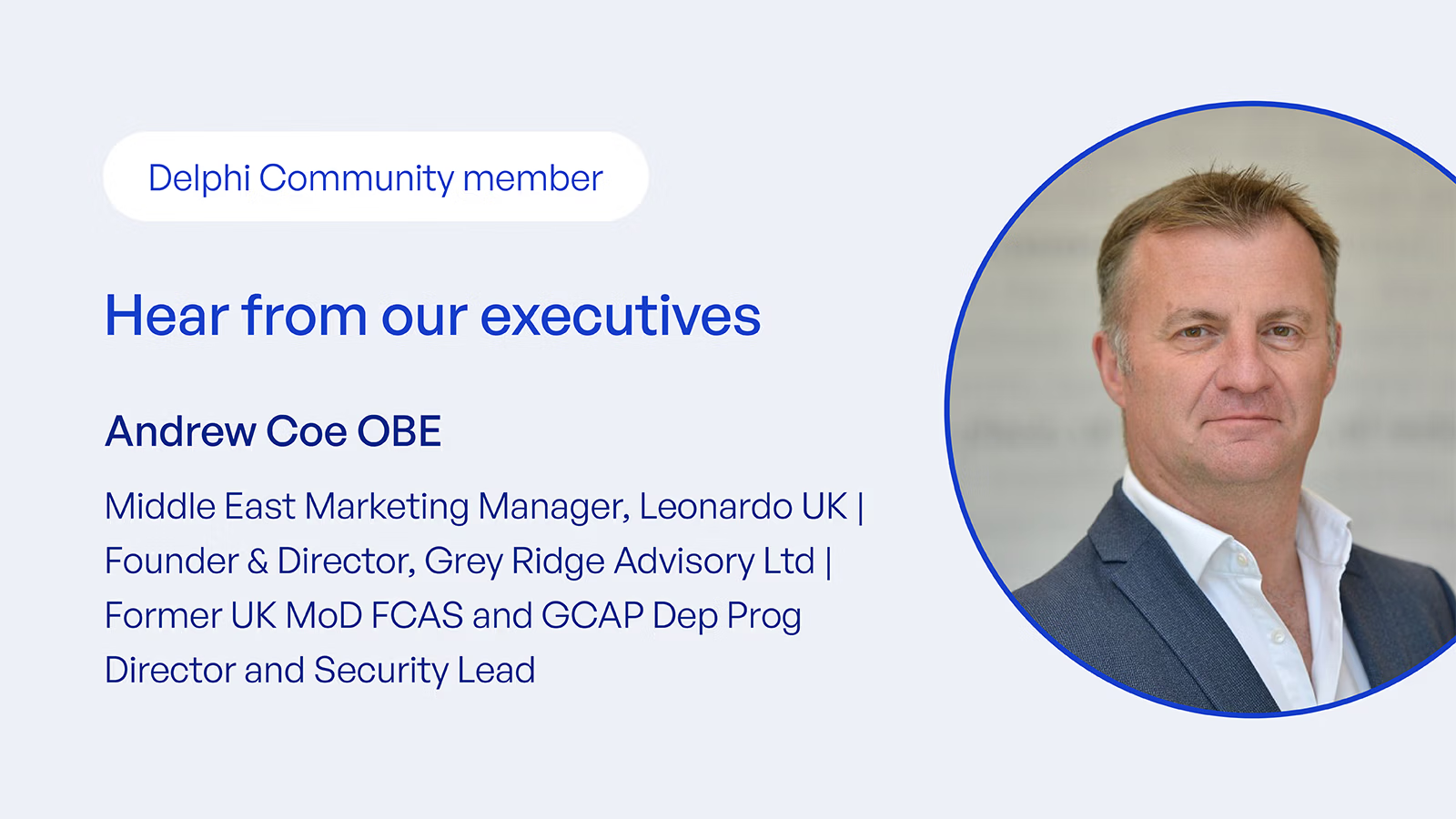

By Andrew Coe OBE
Middle East Marketing Manager, Leonardo UK | Founder, Grey Ridge Advisory Ltd
Twenty-one miles wide. That is the entirety of the Strait of Hormuz at its narrowest point. Since military escalation effectively closed the passage to commercial shipping on 28 February 2026, that measurement has taken on a different kind of significance for every CFO, CSCO and board risk committee trying to make sense of what just happened to their operating model.
This is not a Middle East problem. It never was.
The Signal Was There
The closure did not arrive without warning. The geopolitical conditions that make any chokepoint vulnerable, great power competition, regional instability, threats operating below the threshold of open conflict, have been visible and accelerating for the better part of a decade. The Red Sea disruptions of 2023 and 2024 were a rehearsal. Structured threat assessments circulating among defence and critical infrastructure clients in late 2025 had already identified Hormuz as a high-probability disruption scenario, and the organisations that acted on that analysis entered February 2026 with their exposure mapped and their options open. The warning was written clearly in those events, and yet most organisations treated them as anomalies rather than evidence of a structural shift in the trading environment.
The numbers that followed were stark. Ship transits through the Strait dropped from around 130 per day in February to just six in March, a collapse of approximately 95%. The head of the International Energy Agency, Fatih Birol, described the shutdown as "the largest supply disruption in the history of the global oil market." Global merchandise trade growth is now expected to fall from roughly 4.7% in 2025 to between 1.5% and 2.5% in 2026. Brent crude has risen above $90 per barrel, and the secondary shocks, freight inflation, raw material scarcity, force majeure disputes, insurance withdrawal, are compounding weekly.
The question executives should be sitting with is not what happened. It is why so many organisations, with access to the same open-source picture, were still caught without a workable plan B.
Built for a World That No Longer Exists
The honest answer is that most organisations were designed for a different environment, a period of exceptional global stability, predictable trade flows, and a commercial logic that placed cost efficiency above all other considerations.
Lean inventory models, single-source supplier relationships, and just-in-time logistics are not inherently flawed. They are strategies optimised for conditions that no longer reliably hold. When the Hormuz closure came, organisations with no buffer and no alternative routing absorbed every stage of the cascade simultaneously: energy into freight, freight into inputs, inputs into production, production into customer commitments.
And the exposure ran deeper than most boards had mapped. Beyond the oil and gas headlines, the disruption hit methanol, aluminium, sulphur, graphite and fertilisers, industrial essentials that underpin manufacturing and food supply chains worldwide. An April 2026 report in the British Medical Journal made the point bluntly: a missile strike in Qatar or Saudi Arabia can theoretically cause a shortage of intravenous bags in Bangkok, catheters in Brussels, or halt MRI machines in Brisbane. The connectivity is real, and it runs in directions most risk registers never captured.
What Resilience Actually Looks Like
The word has become a management platitude. Most organisations claim to have resilience. Far fewer have built it in any meaningful operational sense.
The distinction that matters is between resilience as a compliance posture and resilience as something deliberately engineered into the operating model. The former, a business continuity plan filed annually, a risk register reviewed quarterly, provides the appearance of preparedness without the substance. The latter requires something harder: investment in redundancy, alternative sourcing, geographic diversification, and the intelligence infrastructure to identify when the risk environment is shifting before it forces a decision under pressure.
The sectors least damaged by the Hormuz disruption share a common characteristic. They had already accepted some inefficiency in their supply chains in exchange for optionality. They held strategic inventory. They had relationships with alternative carriers. They had mapped their tier-two and tier-three supplier dependencies, not just their direct suppliers. And they had people whose job it was to watch the geopolitical environment and translate what they saw into operational decisions before those decisions became urgent.
That last point is where the structural gap sits. Most organisations have risk functions focused on financial, regulatory and cyber risk. Very few have invested in the kind of geopolitical and security intelligence that would have flagged the Hormuz trajectory eighteen months before the closure. From direct experience advising organisations in this sector, the greatest operational risk in a long, spreading conflict is the problem you do not see coming until it hits. The investment case for supply chain intelligence, enhanced supplier communication protocols, third-party risk monitoring, logistics tracking at tier-two and beyond, has rarely been easier to make than it is now.
The Intelligence Gap
There is a distinction worth drawing between information and intelligence. Information has not been the problem. Every executive in the world has had access to the same news cycle, the same analyst commentary, the same geopolitical reporting. What the Hormuz crisis exposes is an intelligence failure, the difficulty of converting available information into timely, operationally relevant decisions.
Military organisations have grappled with this for decades and developed structured approaches to it: threat assessment frameworks, scenario planning, deliberate red-teaming, and the discipline of asking not "what is happening?" but "what does this mean for our position, and what do we need to do before it forces our hand?" These approaches translate directly into commercial settings. Organisations that have imported them, formally or informally, have consistently performed better in crisis conditions than those relying on reactive management.
The scenarios playing out around Hormuz were not unpredictable. The conditions for a prolonged chokepoint closure — state-level conflict, hybrid maritime threats, insurance market withdrawal, and the absence of scalable bypass infrastructure — were assessable from open sources well in advance. According to Accenture's Pulse of Change survey published in February 2026, 76% of global supply chain executives anticipated continued higher levels of disruption in 2026, yet only 38% felt prepared for geopolitical strife specifically. The gap between anticipating disruption and being positioned to absorb it is where most organisations are still falling short. Speed of response is not the core issue. The decision to build resilience needs to be made long before the disruption arrives.
What Boards Should Be Asking
The immediate pressures — securing alternative supply, renegotiating contracts, managing freight cost increases — are being dealt with across affected industries, with varying results. The more important work is what the Hormuz crisis reveals about strategic positioning going forward.
Three questions deserve board-level attention.
Does your organisation have a genuine picture of its geopolitical exposure? Not a risk register entry, but a mapped understanding of which physical chokepoints, supplier concentrations and regulatory jurisdictions create material vulnerability — and at what threshold that vulnerability becomes critical.
Is your resilience investment proportionate to your actual exposure? Most companies are still saying "resilience" while acting as though cost is the only metric that matters. The organisations getting this right treat it as a prioritisation problem: high-impact freight gets protected, flexible freight gets optimised. Applying uniform logic across a supply chain that carries very different levels of risk is an expensive mistake.
At what point does disruption become a permanent feature rather than a temporary one? Even as diplomatic efforts continue, security incidents around the Strait continue to underline the fragility of the situation. The scenario in which Hormuz becomes a persistently militarised chokepoint, not closed, but permanently elevated in cost, risk and insurance premium, deserves serious board time. It is no longer a tail risk in any meaningful sense.
The Q&A
How should a CEO distinguish between a short-term operational disruption and a structural shift that demands a strategic response?
Watch the direction of travel in the underlying conditions, not just the severity of the immediate shock. A temporary closure driven by a discrete event is operationally serious but manageable. A closure driven by structural conflict, eroding deterrence and converging hybrid threats is different in kind. The right question is not "when will this end?" but "what does the environment look like if it does not end on the timeline we expect — and are we set up for that?"
What does genuine supply chain resilience cost, and how should boards think about the return?
More than efficiency. In inventory carrying costs, in redundant supplier relationships, in the overhead of ongoing monitoring. The return is invisible until disruption arrives, which makes it politically difficult to justify in stable periods. The Hormuz crisis provides the counterargument: the cost of not having invested, emergency freight premiums, production halts, customer attrition, contract disputes, is typically a multiple of the investment that would have prevented it.
Where should organisations focus their intelligence investment now?
Mapped exposure at tier-two and tier-three supplier level, active monitoring of maritime and logistics chokepoints, and scenario planning that model’s operational continuity under a range of geopolitical trajectories rather than just the base case. The gap between organisations that have this and those that do not is not primarily a technology gap. It is a judgement gap, and judgement requires people who understand how these environments actually work, not just how they look on a dashboard.
How does a CEO stop the organisation becoming habituated to persistent friction in a way that blinds it to a deeper rupture?
The muddy middle, fragile truces, partial access and sporadic incidents is where most organisations are right now, and it is the most strategically dangerous position to be in. The friction is manageable enough to avoid triggering a decisive response, but persistent enough to erode margins and attention simultaneously. The answer is a pre-committed trigger framework: agreed indicators, reviewed at set intervals, at which a predetermined strategic response is activated regardless of short-term commercial pressure. Waiting until the crisis forces the decision is, by definition, too late.
1IEA, Oil Market Report, March 2026. iea.org/reports/oil-market-report-march-2026. Birol's characterisation was also repeated publicly at CNBC CONVERGE LIVE, Singapore, 23 April 2026. cnbc.com/2026/04/23/oil-markets-prices-fuel-shortages-iran-war-iea-chief.html
2Accenture, Pulse of Change: Supply Chain Report, February 2026. supplychainbrain.com/articles/43389
Andrew Coe OBE is a senior defence and security practitioner with over 30 years of experience across military operations, international defence programmes and industry. He currently works at the intersection of defence innovation, capability development and international partnership.
Andrew is Head of Middle East Marketing for Leonardo, where he leads regional market strategy and senior engagement across the Middle East. His role focuses on aligning advanced defence and security technologies with partner nation requirements, building trusted long-term relationships and supporting the introduction of new capabilities into complex operational environments.
Alongside this, Andrew is the founder of Grey Ridge Advisory, a specialist consultancy providing discreet strategic advice to governments, industry and senior leaders. His work spans defence and security resilience, intelligence, transformation, leadership, and risk across physical, personnel, information, cyber and supply-chain domains, supported by a trusted network of experienced practitioners.
Andrew also continues to serve as a military reservist, maintaining close links to current defence thinking and NATO priorities. He is a mentor within the NATO DIANA programme, where he supports start-ups and innovators working in the dual-use and defence space. His mentoring focuses on helping teams understand real operational problems, user needs, adoption pathways and the practical challenges of delivering innovation at scale within defence.
Formerly a Royal Air Force fast-jet pilot and senior officer, Andrew held a range of command, operational and staff appointments, including combat operations, expeditionary command, NATO air policing, and senior roles in the UK Ministry of Defence. He is a fellow of the Royal Aeronautical Society and was appointed an Officer of the Most Excellent Order of the British Empire for leadership and operational achievement.